
Table of Contents
Radio-Controlled (RC) cars are far more than just sophisticated toys. From affordable, ready-to-run models to complex, high-performance kits, RC hobbyism offers a spectrum of engagement. If you are considering jumping into this hobby, or perhaps introducing it to a young enthusiast, understanding the balanced view of its pros, cons, and surprising educational value is essential.
What is RC Hobbyism?
An RC car (also known as a remote-controlled car) is a self-powered model vehicle that can be controlled from a distance using a specialized transmitter or remote. Unlike simple, single-button toy cars, true RC hobby models feature independent suspension, proportional steering and throttle, modular components, and impressive speed and durability.
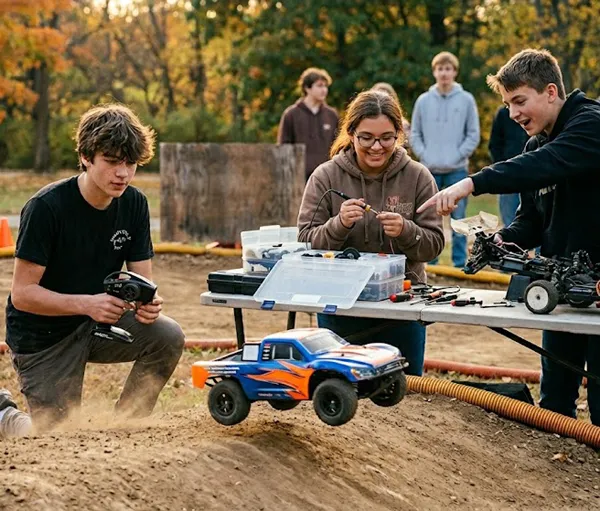
Part 1: The Pros (Why We Love RC Cars)
1. Pure, Adrenaline-Pumping Fun
There is a unique thrill in controlling a fast machine. Whether it’s a buggy clearing huge jumps at the local dirt track, a monster truck crushing obstacles, or a slick drift car sliding through corners, the sensory experience—the sound, the speed, the physics—is intensely satisfying.
2. Social and Community Building
The RC hobby is deeply social. There are countless local clubs, dedicated outdoor and indoor tracks, and massive online communities. Meetups offer a chance to share tips, race, and make new friends who share your passion.
3. Modularity and Customization
This is where the ‘hobby’ aspect shines. Unlike most toys, RC cars are designed to be broken and repaired. Almost every component can be upgraded, from the motor, battery, and electronic speed controller (ESC) to the tires, chassis, and body shell. This allows for deep personalization.
4. Accessibility to Modern Engineering
RC models employ sophisticated technology, including lithium-polymer (LiPo) batteries, brushless motors, sophisticated suspension geometry, and digital radio systems (like 2.4GHz), all in a miniaturized, accessible package.
Part 2: The Cons (The Challenges and Reality)
1. Initial and Ongoing Costs
This is the biggest hurdle. A quality hobby-grade setup (car, batteries, charger, remote) can cost several hundred dollars initially. Furthermore, racing involves entry fees, specialized tires, and replacement parts. It is a hobby that consistently requires a financial commitment.
2. Maintenance and Repair Time
If you run it hard, you will break it. RC cars require constant maintenance. Every run on dirt, gravel, or asphalt introduces stress, dust, and wear. Spending more time cleaning, diagnosing failures, and waiting for parts than actually driving is a common experience.
3. Safety Hazards (Specifically LiPo Batteries)
Modern high-performance RC cars use LiPo batteries. While powerful, they are volatile if mistreated. They require specialized chargers, balancing, safe storage (like a fireproof bag), and proper disposal. Ignoring battery safety is dangerous.
4. Steep Learning Curve for Complex Tasks
While driving is intuitive, setting up complex suspensions (camber, toe, shock tuning), programming sophisticated ESCs, or building kits from scratch demands patience, specific tools, and technical knowledge that takes time to acquire.
Part 3: The Educational Value (More Than Just a Hobby)
This is often the most overlooked aspect. Beyond the fun, engaging with RC hobbyism provides profound STEM (Science, Technology, Engineering, Math) learning opportunities.
1. Hands-on Mechanics and Engineering
When a child or adult builds a kit or repairs a suspension linkage, they are directly applying principles of mechanical engineering. They learn about levers, gear ratios, torque, friction, and structural integrity. They must understand the function of every part to assemble and tune it.
2. Practical Electronics and Physics
Tuning an RC car is an application of physics. Students learn how geometry affects handling, how weight distribution changes grip, and how aerodynamics works. On the electronics side, they gain practical knowledge of circuits, voltage, current (Amps), motor winding (Turns/KV), and how different signals (PWM) translate to mechanical movement.
3. Problem-Solving and Patience
When something fails, the RC hobbyist must troubleshoot. This involves systematic diagnosis: Is it the battery? The motor? The receiver binding? This iterative process of testing and solving problems builds critical thinking, resilience, and patience.
4. Precision and Fine Motor Skills
Operating a controller requires precise eye-hand coordination, especially during high-speed racing or detailed rock crawling. Building or soldering small components enhances fine motor skills.
Conclusion: Is RC Right for You?
The world of RC cars is dynamic, rewarding, and exceptionally educational. It’s a perfect bridge for converting abstract science and engineering concepts into concrete, hands-on experiences. However, it is not an impulse purchase. It demands investment—both time and money—and a serious approach to maintenance and safety.