Table of Contents
Kitchen toys have been a staple in playrooms for generations. Whether it’s a vintage wooden stove or a high-tech plastic kitchenette with sizzling sounds, these toys do more than just keep kids busy—they serve as a miniature laboratory for life skills.
The Advantages: Why They are a “Must-Have”
1. Mastery of Fine Motor Skills
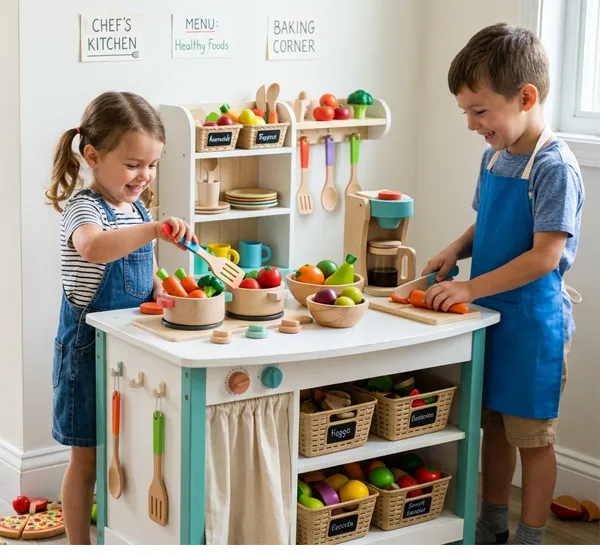
Operating a toy kitchen requires precision. From gripping a small spatula to turning tiny knobs and “slicing” Velcro-connected vegetables, children are constantly refining their hand-eye coordination. These movements build the dexterity needed for later tasks like writing and using real utensils.
2. Language and Social Growth
Kitchen play is inherently social. When children play together, they learn to negotiate (“I’m the chef, you’re the server”), follow sequences, and expand their vocabulary. They begin to use descriptive words like boiling, spicy, crispy, and sizzling, bridging the gap between observation and expression.
3. Cognitive Development and Basic Math
Role-playing in a kitchen introduces early mathematical concepts. Counting out four plates, dividing a pizza into equal slices, or setting a “timer” for ten minutes helps children grasp numbers and time management in a practical, hands-on way.
4. Encouraging Healthy Eating Habits
Exposure to toy versions of broccoli, fish, and exotic fruits can actually reduce “food neophobia” (the fear of new foods). By “cooking” these items during playtime, children become more comfortable with the idea of eating them at the dinner table.
The Disadvantages: The Trade-offs
1. The Footprint and Portability
Perhaps the biggest drawback is the physical space. Unlike a box of LEGOs or a plush toy, a play kitchen is often a semi-permanent furniture piece. In smaller homes or apartments, it can dominate a room and is not easily tucked away when guests arrive.
2. Maintenance of Small Parts
A kitchen is only as good as its accessories. However, keeping track of 50+ pieces of plastic fruit, cutlery, and plates can be a nightmare. These small parts frequently end up under couches or at the bottom of unrelated toy bins, leading to “incomplete” sets that lose their play value over time.
3. Safety and Hygiene Concerns
Since kitchen play often mimics real eating, children are prone to putting these toys in their mouths. Plastic sets with many crevices can trap bacteria, and if a child decides to add “real” water or juice to their play, cleaning becomes a much more frequent and tedious chore.
4. Material Longevity vs. Modern Features
There is often a trade-off between charm and functionality.
- Wooden sets are durable and aesthetically pleasing but can be heavy and lack interactive features.
- Plastic sets often include lights and sounds (which can be noisy for parents) but are prone to cracking or peeling stickers over time.
Summary Table: Quick Comparison
| Category | Advantage | Disadvantage |
| Development | Enhances fine motor & social skills. | Can become repetitive without new “ingredients.” |
| Space | Acts as a central “play hub.” | High floor-space requirement. |
| Cost | High replay value over several years. | Quality sets (especially wood) can be expensive. |
| Cleanup | Teaches kids to “tidy up” their kitchen. | Dozens of small pieces are easily lost. |
Final Thoughts
Kitchen toys are an investment in a child’s imagination. While they require a bit of floor space and some organization to keep the accessories together, the developmental payoffs—ranging from math skills to social confidence—make them one of the most rewarding toy categories available today.