
Table of Contents
Toy drones have become incredibly popular, offering a fun and accessible entry into the world of aerial robotics. One of the most impressive features, especially for beginners, is their ability to maintain stable flight and even hover in place. But how do these miniature marvels achieve such precision? Let’s dive into the technology that makes it all possible.
The Fundamentals of Flight Stability
At the heart of any drone’s stability are its motors and propellers. Most toy drones are quadcopters, meaning they have four propellers. Each propeller is driven by an independent motor. The drone achieves movement and stability by precisely controlling the speed of these motors.
- Lift and Thrust: Each propeller generates lift by pushing air downwards. To ascend, all motors increase speed simultaneously. To descend, they slow down.
- Pitch and Roll: To move forward or backward (pitch), the drone increases the speed of the rear motors and decreases the speed of the front motors, or vice-versa. To move left or right (roll), it adjusts the speed of the motors on one side relative to the other.
- Yaw (Rotation): To rotate clockwise or counter-clockwise, the drone uses a clever trick. Two propellers spin clockwise, and two spin counter-clockwise. By slightly increasing the speed of the counter-rotating pairs and decreasing the speed of the other pair, the drone can yaw.
The Role of the Flight Controller
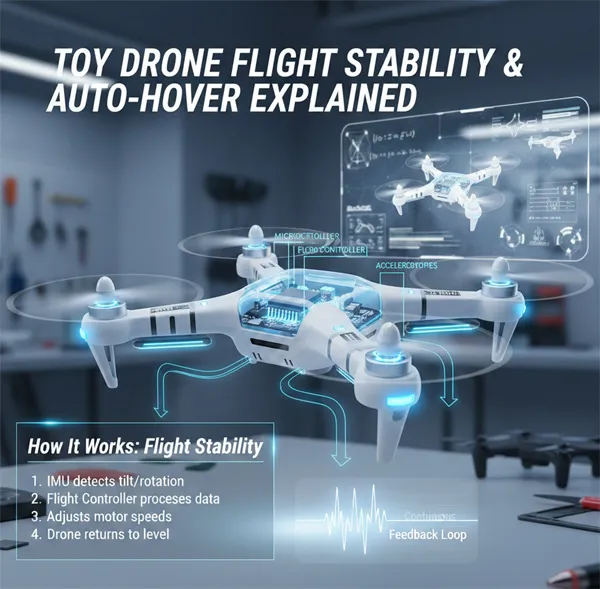
While the motors and propellers provide the physical means of flight, the flight controller is the brain of the operation. This small circuit board contains several crucial components:
- Microcontroller: This is the central processing unit that executes the flight control algorithms.
- IMU (Inertial Measurement Unit): This is perhaps the most critical component for stability. The IMU typically includes:
- Accelerometers: These sensors measure the drone’s acceleration in three dimensions, helping it understand its orientation relative to gravity.
- Gyroscopes: These sensors measure the drone’s angular velocity, detecting any rotational movements or tilts.
The flight controller constantly reads data from the IMU. If the drone starts to tilt due to wind or an uneven thrust, the gyroscopes and accelerometers detect this change. The microcontroller then processes this information and sends immediate commands to the motors to adjust their speeds, counteracting the tilt and bringing the drone back to a stable, level position. This continuous feedback loop happens hundreds of times per second, making the adjustments seem instantaneous.
Auto-Hover: Staying Put in the Air
Auto-hover, also known as altitude hold, is an advanced feature that allows the drone to maintain a consistent altitude without constant throttle input from the pilot. This feature greatly simplifies flying, especially for beginners.
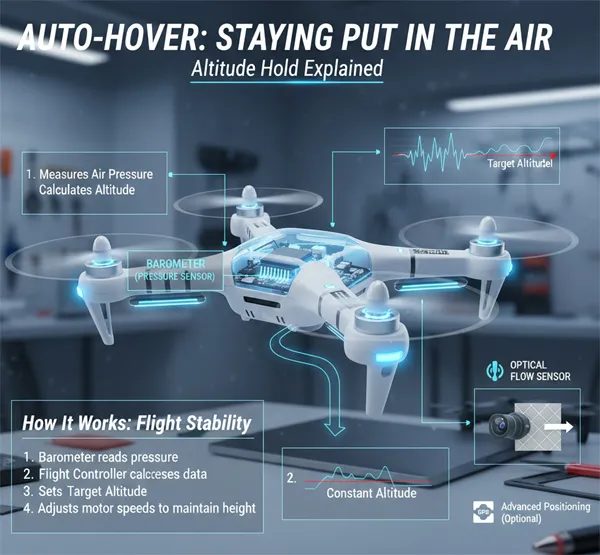
The key to auto-hover is the barometer (pressure sensor). This sensor measures the atmospheric pressure around the drone. Since air pressure changes with altitude, the flight controller can use this information to determine the drone’s height above the ground.
Here’s how it works:
- Pressure Reading: The barometer continuously measures the ambient air pressure.
- Altitude Calculation: The flight controller converts this pressure reading into an estimated altitude.
- Target Altitude: When you activate auto-hover, the drone records its current altitude as the target.
- Throttle Adjustment: If the drone drifts up, the barometer detects a drop in pressure, and the flight controller slightly reduces the motor speeds to bring it down. If it drifts down, the pressure increases, and the motors speed up. This constant adjustment keeps the drone at the desired height.
Some more advanced toy drones, and certainly professional drones, also incorporate optical flow sensors or GPS for even more precise positioning, especially when hovering horizontally. Optical flow sensors essentially act like a camera looking at the ground, detecting movement and helping the drone stay in place even without GPS.
Why is Stability Important?
- Ease of Use: Stable flight makes drones much easier for beginners to learn and control.
- Better Photography/Videography: Even on toy drones with cameras, stability is crucial for capturing clear, steady footage.
- Safer Flying: A stable drone is less likely to drift uncontrollably and potentially hit obstacles or people.
Conclusion
The seemingly simple act of a toy drone hovering steadily in the air is actually the result of sophisticated engineering. The combination of precisely controlled motors, an intelligent flight controller, and an array of sensors like accelerometers, gyroscopes, and barometers work in harmony to provide an enjoyable and stable flying experience for pilots of all skill levels. So next time you see a toy drone gracefully holding its position, you’ll know the incredible technology at play!