
Table of Contents
One of the most exciting features of modern toy drones is the ability to capture aerial footage and photos. Many drones now come equipped with cameras, transforming them into personal flying photographers. However, when you’re looking to buy, you’ll often see terms like 720p, 1080p, and FPV. What do these mean for your flying and filming experience? Let’s break it down.
Understanding Resolution: 720p vs 1080p
Resolution refers to the number of pixels that make up an image or video. More pixels generally mean more detail and a clearer picture.
- 720p (HD – High Definition):
- Resolution: 1280 pixels wide by 720 pixels high.
- What it means for you: This is the entry-level for HD video. Footage captured at 720p will look decent, especially when viewed on smaller screens like a smartphone. It’s usually good enough for casual sharing on social media or for beginners who are just starting to experiment with drone photography. You’ll see reasonable clarity, but fine details might be a bit blurry or pixelated when zoomed in or viewed on a larger display.
- Pros: Lower file sizes, often found on more affordable drones.
- Cons: Less detail, can appear pixelated on large screens.
- 1080p (Full HD – Full High Definition):
- Resolution: 1920 pixels wide by 1080 pixels high.
- What it means for you: This is a significant step up from 720p and is considered standard for many video applications today. 1080p footage offers noticeably sharper images and more detail, making it much more enjoyable to watch on larger monitors, TVs, or tablets. If you’re planning to share your drone videos on platforms like YouTube or want a more professional-looking result, 1080p is the minimum you should aim for.
- Pros: Much sharper and more detailed than 720p, great for sharing and viewing on various devices.
- Cons: Larger file sizes, drones with 1080p cameras might be slightly more expensive.
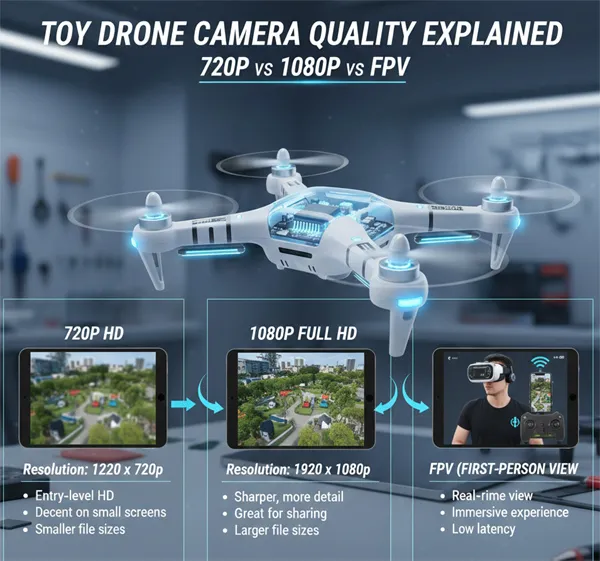
FPV: First-Person View – An Immersive Experience
FPV isn’t a resolution like 720p or 1080p; instead, it describes a method of viewing. FPV allows you to see what your drone’s camera sees in real-time, as if you were sitting in the cockpit yourself.
- How it Works: The drone’s camera transmits a live video feed to a receiver, which can be connected to:
- A smartphone app: The most common setup for toy drones. Your phone attaches to the controller, displaying the live view.
- Dedicated FPV goggles or screen: Some drones offer this for an even more immersive experience.
- What it means for you:
- Immersive Flying: FPV transforms flying from observing a drone in the sky to actually “being” in the air. This is fantastic for exploring, navigating obstacles, and getting a true bird’s-eye perspective.
- Precise Control: With a direct view from the drone, you can fly with much greater precision, especially when trying to get specific shots or navigating tight spaces.
- Racing: FPV is essential for drone racing, where pilots wear goggles to navigate complex courses at high speeds.
- Latency is Key: For FPV to be effective, the video transmission needs to have very low latency (minimal delay). A high-latency FPV feed can make the drone difficult to control, as what you see isn’t truly “live.”
- Resolution in FPV: While the FPV feed itself might be transmitted at a lower resolution (e.g., 480p or 720p) to ensure low latency, the drone’s onboard recording (to an SD card) can still be at a higher resolution like 1080p. So, you might fly with a 720p FPV view but record stunning 1080p footage.