Table of Contents
Jenga is one of those rare games that can turn a quiet table into a stage of suspense, laughter, and sudden chaos. With nothing more than a tower of wooden blocks and steady hands, Jenga has become a timeless classic enjoyed by children, families, and adults all over the world.
What Is Jenga?
Jenga is a physical skill and strategy game originally created by Leslie Scott in the 1970s and later popularized worldwide. The name comes from a Swahili word meaning “to build.” The game is simple in concept but endlessly exciting in practice.
A standard Jenga set consists of 54 rectangular wooden blocks. At the start of the game, the blocks are stacked into a tower of 18 levels, with three blocks per level, alternating directions at each layer.
How to Play Jenga
- Build the Tower
Stack the blocks neatly to form a stable tower on a flat surface. - Take Turns
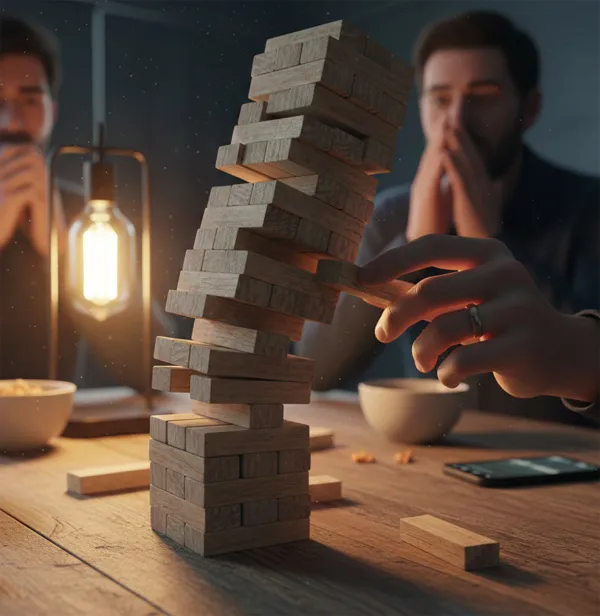
Players take turns removing one block at a time from anywhere below the top completed layer. Only one hand may be used. - Place on Top
The removed block is placed on the very top of the tower, completing a new level if possible. - Keep It Standing
As the game progresses, the tower becomes taller and increasingly unstable. - Game Over
The player who causes the tower to collapse loses the game.
Why Jenga Is So Much Fun
1. Pure Suspense
Every move feels critical. The slight wobble of the tower, the sound of shifting wood, and the collective breath-holding make each turn thrilling.
2. Easy to Learn, Hard to Master
Jenga has very simple rules, but mastering balance, block selection, and hand control takes practice and patience.
3. Social Interaction
Jenga naturally brings people together. Whether it’s playful teasing, nervous laughter, or cheering when a block slides out cleanly, it’s a fantastic social game.
4. Skill and Strategy
Despite its simplicity, Jenga is not just luck. Players learn to:
- Identify loose blocks
- Read weight distribution
- Decide between safe and risky moves
Benefits of Playing Jenga
- Improves hand–eye coordination
- Develops fine motor skills
- Encourages strategic thinking
- Teaches patience and focus
- Great for stress relief and fun
Because of these benefits, Jenga is often used in classrooms, therapy sessions, and team‑building activities.
Popular Jenga Variations
- Giant Jenga – Oversized blocks for outdoor play
- Truth or Dare Jenga – Each block has a written challenge
- Color Jenga – Dice determine which color block to remove
- Speed Jenga – Play under time pressure for extra excitement
Jenga for All Ages
One of Jenga’s greatest strengths is its universal appeal. Children enjoy the physical challenge, adults enjoy the strategy, and families enjoy the shared experience. No batteries, no screens—just simple wooden blocks and unforgettable moments.
Final Thoughts
Jenga proves that great games don’t need complex rules or flashy technology. With balance, concentration, and a bit of courage, every round tells its own story. Whether you’re playing casually at home or competitively with friends, Jenga never fails to deliver excitement—right up until the tower comes crashing down. If you’re looking for a game that combines tension, laughter, and timeless fun, Jenga is always a perfect choice.