
Table of Contents
The LEGO Architecture series is a favorite among adult builders, offering stunning, scaled-down replicas of the world’s most iconic landmarks. But for a new builder, or one looking for their next serious challenge, how do you rank the difficulty?
It’s not just about the number of pieces. The true difficulty in LEGO Architecture comes from a blend of size, repetition, color palette, and the genius of the required building techniques.
🏗️ What Makes a LEGO Architecture Set Difficult?
Before diving into the ranking, it’s crucial to understand the factors that turn a relaxing build into a true test of patience and skill:
- Piece Count & Scale: This is the most obvious factor. Sets over 3,000 pieces (like the Taj Mahal or Eiffel Tower, though technically Icons/Creator Expert sets, they are architecturally focused) require significant time commitment and stamina.
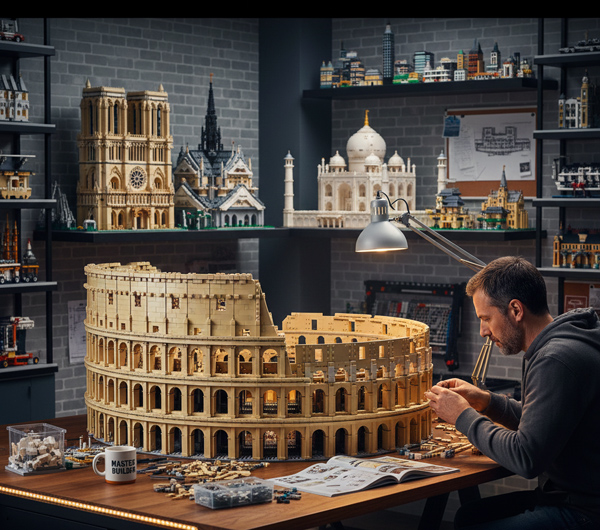
- Repetition: Many large structures (especially pyramids, castles, or circular arenas like the Colosseum) involve building the same structural unit hundreds of times. This requires concentration and can become mentally taxing.
- Monochromatic Color: Sets that rely heavily on a single color (like the Colosseum’s tan bricks or the Statue of Liberty’s sand green/beige) make part identification harder, especially in low light.
- Complex Geometry: Architecture sets often use SNOT (Studs Not On Top) techniques and intricate angles to capture the real-world curves and slopes, which are far trickier than standard vertical stacking.
- Internal Structures: Large, hollow models need surprisingly dense and complex internal Technic frames to support the weight and maintain rigidity, which can be challenging to construct and align perfectly.
🏆 The Unofficial Difficulty Ranking
The LEGO Architecture theme has two main sub-groups: the smaller Skylines and the larger, more detailed Landmark series.
Tier 3: Beginner Architect (Skylines & Simple Landmarks)
These sets are generally fast, satisfying builds perfect for beginners or a quick session. The focus is on recognizable silhouettes using fundamental building techniques.
- Example Sets: Most Skylines (e.g., London, Paris, Tokyo, New York City), The White House
- Difficulty Factors: Low piece counts (under 1,000 pieces), clear, distinct sub-models, and simple, stacked construction.
- Build Time: Typically 1 to 4 hours.
Tier 2: Intermediate Engineer (Medium Landmarks)
This tier includes mid-sized models that introduce SNOT techniques, complex sub-assemblies, and more significant repetition. They require focused attention to detail.
- Example Sets: Statue of Liberty, Great Pyramid of Giza, The Louvre, Trafalgar Square
- Difficulty Factors: Piece counts often ranging from 1,000 to 2,000. The Great Pyramid, for example, requires building a complex cross-section that lifts off, demanding precision. The Statue of Liberty uses subtle angles to shape the flowing robes.
- Build Time: Typically 5 to 10 hours.
Tier 1: Master Builder (The Apex of Architecture)
These are the most time-consuming, intricate, and technically demanding sets, often blurring the line between the Architecture theme and the larger LEGO Icons line due to their sheer scale.
| Set Example | Piece Count | Core Difficulty Challenge |
| Colosseum (10276) | 9,036 | Extreme repetition of tan/sand colored arches; very subtle, gradual curvature that must be maintained over thousands of pieces. |
| Taj Mahal (10256) | 5,922 | Massive piece count and highly repetitive domes and minarets; precision required for symmetrical alignment. |
| Notre-Dame de Paris (21044) | 4,383 | High complexity in achieving the gothic architecture’s intricate curves, buttresses, and spires using micro-scale pieces. |
| Himeji Castle (21060) | 2,125 | While lower on the piece count, it demands advanced techniques to capture the complex, sloping roofs and white/tan color mix for the traditional Japanese architecture. |
🎯 The Verdict: The Hardest Architecture Build
While sets like the Colosseum are often cited as the most tedious due to their monotonous color scheme and repetition, the Notre-Dame de Paris (or similar highly detailed, non-linear structures) typically presents the greatest technical challenge.
These sets require a deeper understanding of advanced techniques to ensure the complex, multi-layered internal structures and external aesthetic details align perfectly. It’s less about building the same thing 500 times and more about building 500 unique, complex connections.