Table of Contents
Beyond simple entertainment, Jenga offers meaningful psychological and educational value, making it popular in schools, therapy settings, and team-building activities.
1. Concentration and Attention Control
Jenga requires players to focus intensely on small movements and subtle changes in balance. This helps train sustained attention and the ability to ignore distractions—skills that are especially valuable for children and adolescents.
2. Emotional Regulation
As the tower becomes unstable, players experience tension and anxiety. Learning to stay calm under pressure helps develop emotional control and stress management, useful both in games and real-life situations.
3. Cause-and-Effect Thinking
Every move directly impacts the stability of the tower. This clear feedback loop strengthens cause-and-effect reasoning, helping players understand consequences in a tangible way.
4. Decision-Making and Risk Assessment
Players must constantly choose between safe moves and risky ones. This encourages critical thinking, probability judgment, and risk evaluation, key components of cognitive development.
5. Social Awareness and Communication
When played in groups, Jenga promotes turn-taking, observational learning, and social interaction. Watching others’ strategies helps players learn cooperation, empathy, and friendly competition.
6. Therapeutic Applications
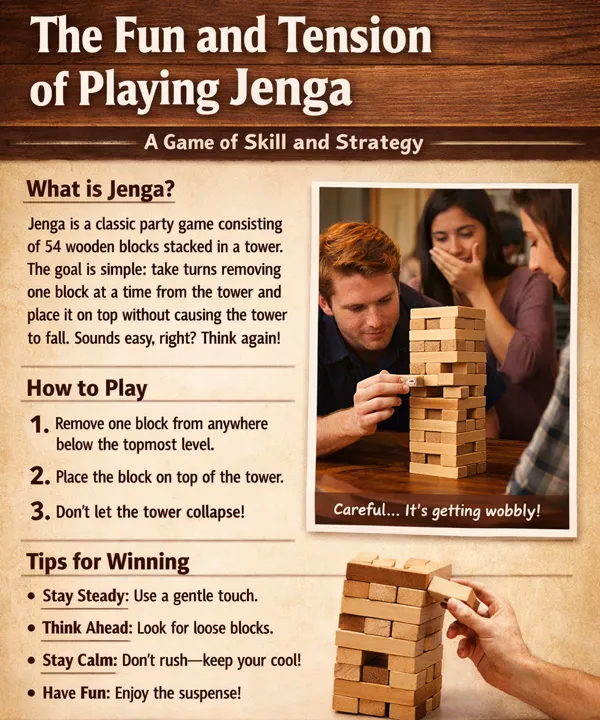
Jenga is often used in occupational therapy and counseling. Therapists adapt the game to:
- Improve fine motor control
- Encourage conversation and emotional expression
- Build confidence through achievable challenges
These benefits make Jenga more than just a game—it becomes a simple yet powerful tool for learning, development, and personal growth.
Because of these benefits, Jenga is often used in classrooms, therapy sessions, and team‑building activities.