
Table of Contents
Hello there, parents, and educators who are deeply interested in children’s growth and development! Today, we’re going to take a deep dive into one of the hottest keywords in the parenting market: ‘Wooden Montessori Toys’.
Have you ever wondered if the colorful plastic toys, noisy gadgets, and blinking lights filling your child’s room are truly best for their development? The Montessori method offers a different answer. It points towards “nature” and “simplicity.”
What is Montessori Education?
Developed by Dr. Maria Montessori, an Italian physician and educator, this method centers on respecting children as independent beings and providing them with an environment where they can learn on their own. The most crucial element in this environment is ‘learning materials’ (often called ‘toys’ but designed with specific purpose). Montessori materials are not just for amusement; they are tools designed to help children grasp specific concepts independently.
Why Must it Be ‘Wood’?
There are several clear reasons why wooden materials are preferred over plastic or metal.
1. Depth of Sensory Experience
Wood has the texture of nature itself. It conveys a variety of sensations to a child’s fingertips—smooth, slightly rough, warm, or cool. While plastic provides a uniform sensation, wood teaches a child about “nature’s changes” and “diversity” sensorially. This has a very positive impact on the development of sensory integration in children.
2. Simplicity and Focus
Toys that make sounds or flash lights grab a child’s attention but easily distract them. Wooden materials, on the other hand, are simple. The child focuses entirely on the shape, weight, and texture of the material. This environment nurtures habits of problem-solving independently and deeply immersing themselves in tasks.
3. Durability and Sustainability
Wooden materials become more beautiful over time and are difficult to break or ruin. They can even be passed down through generations. Furthermore, they are eco-friendly materials that provide a healthy environment for children and naturally teach the important value of environmental protection.
Encountering Wooden Montessori Toys Through Images
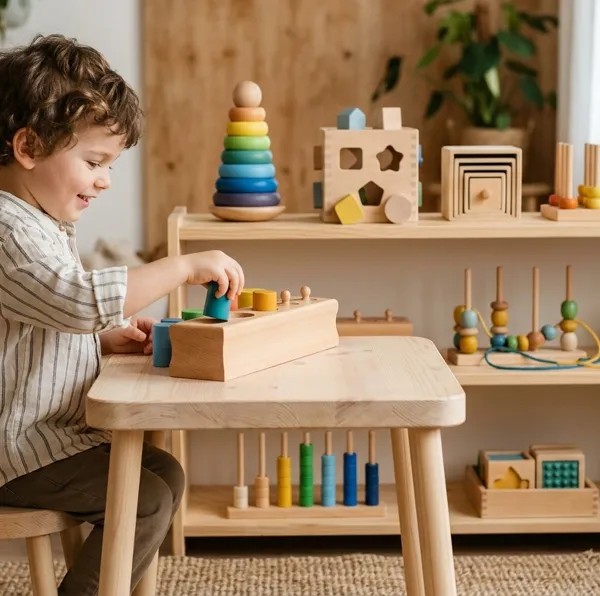
See for yourself the warm and stabilizing feeling that wooden materials offer through the image we created.In the image, a child is concentrated on a wooden ‘Cylinder Block’ material in a warm, inviting room. This material is a representative Montessori sensory material that allows children to recognize differences in size and shape on their own. On the shelves behind, rainbow stacking blocks, shape-sorting boxes, and various wooden puzzles are neatly organized. Wooden materials in themselves make excellent interior décor and provide children with a calm learning environment.
Three Recommended Wooden Montessori Toys
For parents encountering wooden materials for the first time, we recommend these three popular and effective ones.
- Cylinder Blocks: Sensorial learning of changes in size, height, and diameter.
- Pink Tower: Gaining spatial concepts by stacking ten pink cubes in order of size.
- Object Permanence Box: Infant educational materials that teach the concept that an object exists even when it disappears from view.
Closing Thoughts
Wooden Montessori toys offer children value beyond mere play. They are the most natural and powerful tools for nurturing the ability to think, solve problems, and concentrate independently.
This weekend, how about placing a warm wooden material instead of a plastic toy in a corner of your child’s room? You might witness the beautiful sight of your child finding their own path within that simplicity.