
Table of Contents
One of the most common questions new drone enthusiasts (and parents buying for their kids!) ask is: “How long do toy drone batteries actually last?” It’s a crucial factor that can significantly impact the fun factor of these mini flying machines. The short answer is: it varies widely, but often less than you might hope!
Let’s dive into the realities of toy drone battery life, what influences it, and how you can maximize your flight time.
The Reality of Toy Drone Battery Life
Most toy drones are powered by small, lightweight Lithium Polymer (LiPo) batteries, typically ranging from 150mAh to 500mAh (milliampere-hours). Given their small size and the power required to spin four motors, actual flight times are often quite brief.
Average Flight Times:
- Mini/Micro Drones (e.g., Holy Stone HS210, Eachine E010): Expect 5 to 8 minutes per battery charge.
- Small Drones with Cameras (e.g., Ryze Tello, Holy Stone HS110D): These often manage 7 to 13 minutes, as they have slightly larger batteries to power both flight and the camera.
- Larger, More Advanced Toy Drones: Some more robust toy drones might push 10 to 15 minutes, but this is less common for models under $100.
It’s important to note that these are usually optimistic estimates from manufacturers. Real-world performance can be a bit less.
What Affects Battery Life?
Several factors play a significant role in how long your toy drone stays airborne:
- Battery Capacity (mAh): This is the most direct indicator. Higher mAh generally means longer flight time.
- Drone Weight: Heavier drones require more power to stay aloft, draining the battery faster.
- Motor Efficiency: Brushless motors (found in higher-end drones) are more efficient than brushed motors (common in toy drones), providing better flight time for the same power.
- Flying Style: Aggressive flying, fast turns, and rapid ascents and descents consume more power than gentle, steady hovering.
- Wind Conditions (Outdoor Flying): Fighting against wind drastically reduces battery life as the motors work harder.
- Camera Usage: If your drone has a camera and you’re recording video, it will use more power.
- Propeller Damage: Even minor nicks or bends in propellers can make them less efficient, forcing motors to work harder.
- Battery Age/Condition: Over time, LiPo batteries degrade, leading to reduced capacity and shorter flight times.
Real-World Flight Test: An Example
Let’s say you have a popular mini drone like the Holy Stone HS210 with a 250mAh battery.
- Manufacturer Claim: 5-7 minutes.
- Gentle Indoor Flight Test: We might observe 6.5 minutes of mostly hovering and slow maneuvers.
- Aggressive Indoor Flight Test: Hard acceleration and fast movements could bring that down to 5 minutes.
- Slightly Windy Outdoor Flight (not recommended for this drone): If you tried, you’d likely get 3-4 minutes before needing to land.
This highlights that manufacturer claims are often achievable under ideal, gentle conditions.
Tips to Maximize Your Toy Drone’s Battery Life
While you can’t magically double your battery life, you can certainly get the most out of each charge:
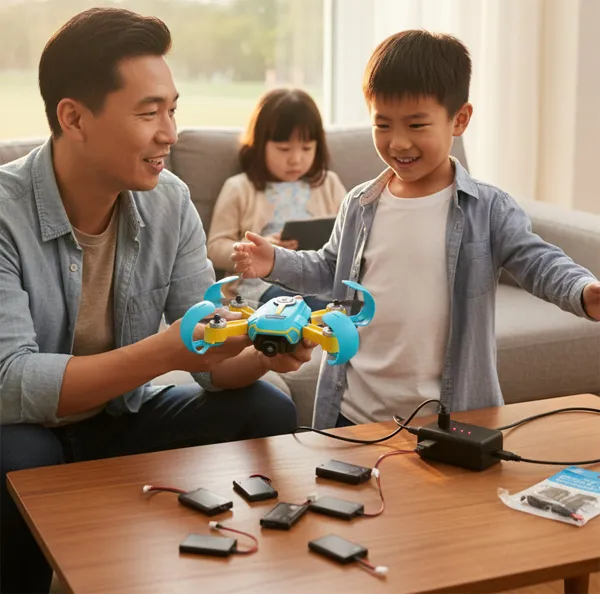
- Buy Extra Batteries: This is by far the best solution! Most toy drones are affordable, and so are their spare batteries. Having 3-5 extra batteries can turn 5 minutes of fun into 20-30 minutes of continuous flying by swapping them out.
- Fly Gently: Smooth, controlled movements are more energy-efficient than erratic, full-throttle flying.
- Avoid Wind: If flying outdoors, choose calm days. Wind is a battery killer for small drones.
- Perform Pre-Flight Checks: Ensure propellers are free of debris and not bent. Even a tiny imperfection can reduce efficiency.
- Don’t Overcharge/Over-discharge:
- Overcharging: Can damage the battery and shorten its overall lifespan. Use the provided charger and disconnect when fully charged.
- Over-discharging: Letting the battery run completely flat can also damage it. Land your drone as soon as you notice a significant drop in power.
- Store Batteries Properly: If you’re not going to use your drone for an extended period, store LiPo batteries at a “storage charge” (around 3.8V per cell) if your charger allows, or at least not fully charged or fully depleted. Store them in a cool, dry place.
- Keep it Lightweight: Avoid adding any unnecessary weight to your drone (unless it’s a specific mod you’re making).
By understanding the limitations and applying these tips, you can significantly enhance your toy drone flying experience and make those precious minutes of flight last longer. Happy flying!