
Table of Contents
For centuries, humans have looked at the night sky and wondered about the mysteries of the universe. While our eyes are remarkable, they have limits. That’s where the telescope comes in—a revolutionary tool that acts as an extension of our vision, bringing distant stars, planets, and galaxies into focus.
But how exactly does a tube of glass or mirrors allow us to see across billions of miles of space? Let’s dive into the mechanics of these incredible “time machines.”
What Is a Telescope?
At its simplest, a telescope is an optical instrument designed to gather light and magnify images. While many people think the primary job of a telescope is to make things look bigger (magnification), its most important function is actually light collection.
The more light a telescope can gather, the clearer and more detailed the distant object will appear. This is why professional telescopes, like the James Webb Space Telescope, are built with massive diameters.
How Does It Work? The Two Key Principles
Telescopes work by using two main processes: Gathering and Focusing.
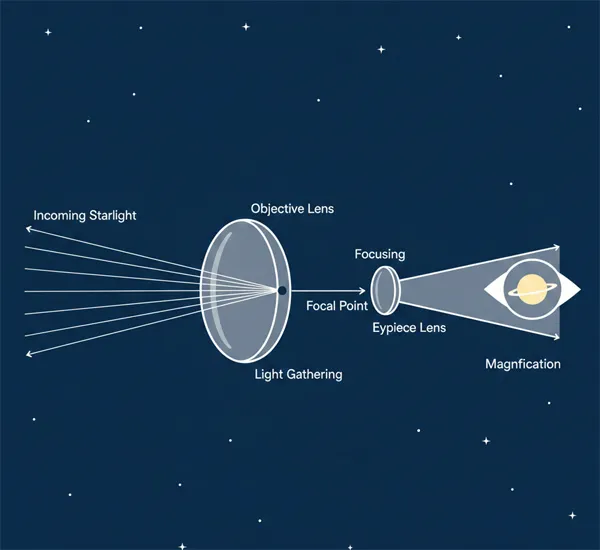
- Light Gathering: The telescope uses a large lens or mirror (called the objective) to collect light from a distant object. A larger objective acts like a “light bucket”—the bigger it is, the more photons it catches.
- Focusing: Once the light is collected, it is bent (refracted) or bounced (reflected) to a single point called the focal point.
- Magnification: An eyepiece lens is then placed at the focal point to enlarge that focused light so it fills your retina, allowing you to see the details clearly.
Here’s an illustration showing the fundamental principle of how a telescope gathers and focuses light:
The Three Main Types of Telescopes
Depending on how they handle light, telescopes generally fall into three categories:
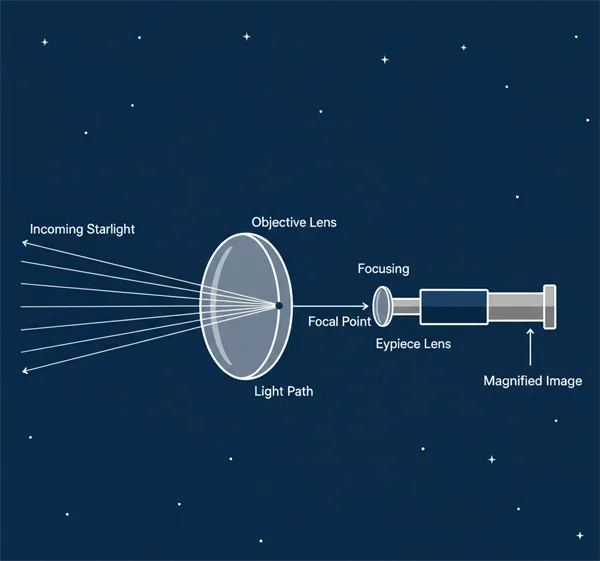
1. Refracting Telescopes (The Classic Design)
Used by Galileo, refractors use glass lenses to bend light. Light enters through a large objective lens at the front and is bent as it travels down the tube to the eyepiece.
- Pros: Very durable and great for viewing planets.
- Cons: Can be heavy and expensive to make with very large lenses, and can suffer from chromatic aberration (color fringing).
2. Reflecting Telescopes (The Modern Standard)
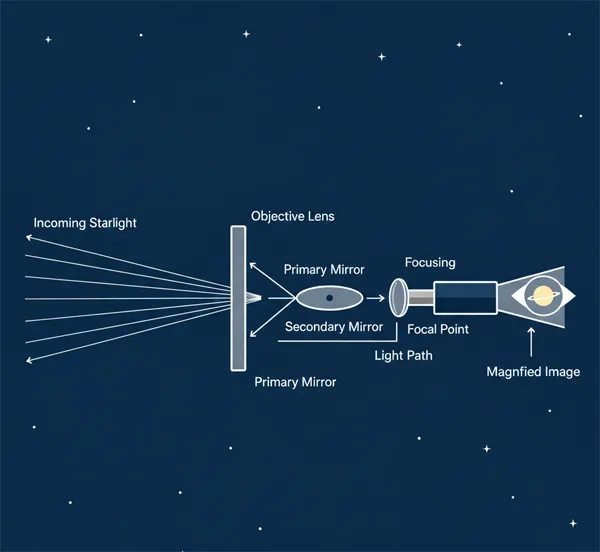
Invented by Isaac Newton, reflectors use curved mirrors instead of lenses. Light hits a primary mirror at the back of the tube, reflects to a secondary mirror, and is then sent to the eyepiece.
- Pros: No “color fringing” (chromatic aberration) and much cheaper to build in large sizes.
- Cons: The mirrors require occasional alignment (collimation).
Below is an illustration showing how a reflecting telescope works:
3. Catadioptric Telescopes (The Hybrid)
These modern telescopes use a combination of both mirrors and lenses. They are popular among amateur astronomers because they are compact and portable while offering high power.
Why Do We Put Telescopes in Space?
You might wonder why we send telescopes like Hubble or James Webb into orbit. The reason is Earth’s atmosphere.
Our atmosphere is turbulent; it shifts the air around, which causes stars to “twinkle” and blurs the light. By placing telescopes in space, we can capture crystal-clear images without the interference of clouds, light pollution, or atmospheric distortion.
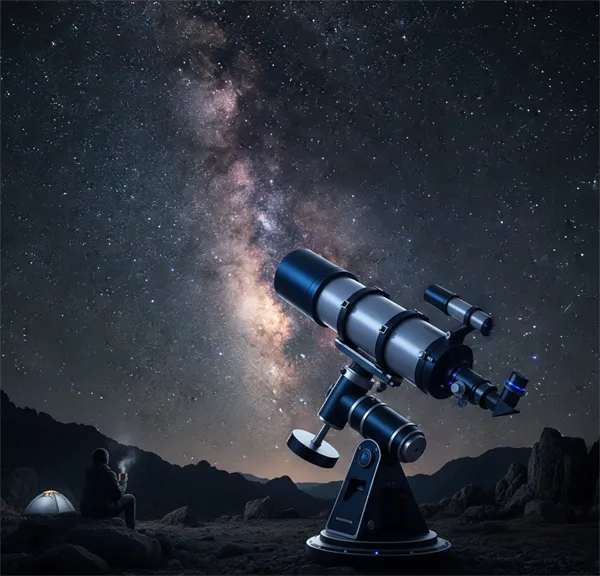
Here’s an image of a sleek, modern telescope pointed towards a star-filled sky, ready to capture distant wonders: