
Table of Contents
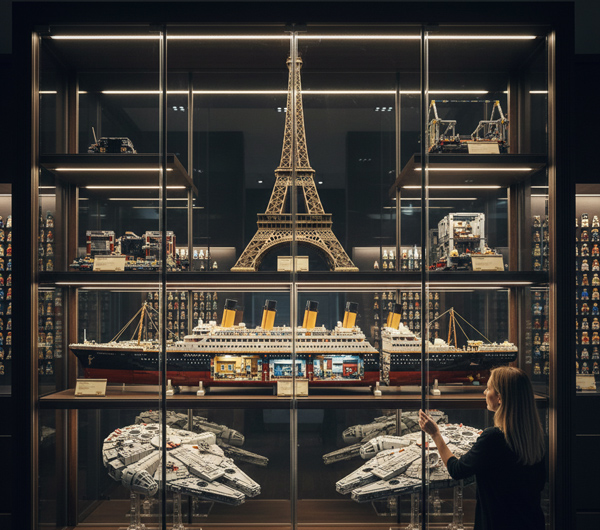
When your Lego collection moves from “small sets on a shelf” to massive icons like the Titanic or the Eiffel Tower, standard furniture just won’t cut it. These sets aren’t just toys; they are architectural statements that require a “Museum Curator” mindset.
Here is how to design an exhibition layout for the giants of the Lego world.
🏗️ 1. The Vertical Giant: Lego Eiffel Tower (10307)
Standing at a staggering 149 cm (58.5 inches), the Eiffel Tower is the tallest Lego set ever. It’s too tall for almost any standard bookshelf.
- The “Plinth” Strategy: Instead of putting it in a cabinet, place it on a low pedestal or plinth. This mimics how statues are displayed in museums. It allows you to walk around it and appreciate the trusswork from all angles.
- Corner Spotlight: Place it in a corner to save floor space, but use uplighting. A small LED puck light at the base pointing upward creates dramatic shadows on your ceiling, mimicking the real night-time Eiffel Tower.
- Floor-to-Ceiling Clear Case: If you have pets or kids, a custom-height acrylic tower is a must. Ensure the base is wide enough (60×60 cm) to prevent tipping.
🚢 2. The Horizontal Behemoth: Lego Titanic (10294)
At 135 cm (53 inches) long, the Titanic’s biggest challenge is its “footprint.” It is incredibly long but very narrow.
- The Sideboard Showcase: A long living-room sideboard or a wide TV console is the natural home for the Titanic.
- The “Floating” Wall Shelf: Use heavy-duty floating brackets anchored into wall studs. If you place the shelf at eye level, it creates a stunning silhouette that looks like the ship is cutting through the horizon of your room.
- The Sectional Exhibit: One unique feature of the Lego Titanic is that it splits into three sections. You can display it “open” with small gaps between the sections to reveal the interior boilers and grand staircase. This turns it from a ship model into a technical cross-section exhibit.
🛸 3. The Depth Defier: Millennium Falcon (75192)
The UCS Millennium Falcon is notoriously difficult because it is both wide and deep, making it too “fat” for most bookshelves.
- The Vertical Stand: Use a specialized third-party angled stand (like those from iDisplayit or Wicked Brick). This tilts the Falcon at a 45-degree or even 70-degree angle, reducing its depth requirement from 80 cm down to about 30 cm.
- The Coffee Table Gem: The Falcon is one of the few sets that looks incredible inside a glass-topped coffee table. It becomes a conversation starter for anyone sitting in your living room.
💡 4. Pro Museum Layout Tips
(1) The “Rule of Three” (Lighting)
Don’t just use your room’s ceiling light. Use a three-point lighting system:
-Key Light: General light so you can see the set.
-Backlight: A strip of LEDs behind the set to separate it from the wall.
-Accent Light: A small spotlight hitting a specific detail (like the Titanic’s funnels or the Falcon’s cockpit).
(2) Information Plaques
To give your room a true museum feel, print or buy custom “UCS-style” information plaques. Placing a small card with the ship’s history or the brick count next to the model immediately upgrades the display from “hobby” to “curated collection.”
(3) Mirror Backings
If you are displaying a set against a wall, place a mirror behind it. This allows you to see the “hidden” side of the model without having to move or rotate a fragile 10,000-piece structure.