
Table of Contents
Flying a drone for the first time is exciting—but it can also be frustrating if you don’t know the basics.
Whether you’re using a toy drone, a beginner drone, or a kids’ drone, learning proper control techniques will help you avoid crashes, extend battery life, and enjoy flying much more.
This guide covers essential drone flying tips and step-by-step usage instructions for beginners.
1. Before You Fly: Essential Preparation
Fully Charge the Battery
Many beginners make the mistake of flying with a partially charged battery.
Low battery voltage reduces motor power and can cause sudden drops.
Tip:
- Always fully charge the battery before flying
- Let batteries cool down before recharging
Choose the Right Flying Location
For beginners, the best place to start is indoors or in a calm, open space.
Ideal beginner locations:
- Living room with furniture cleared
- Empty gym or hall
- Outdoor area with no wind
Avoid:
- Crowded places
- Areas with trees, wires, or water
- Windy outdoor conditions

2. Start Indoors First (Yes, Really)
Even if your drone is advertised as an outdoor drone, indoor practice is highly recommended.
Why indoor flying helps:
- No wind interference
- Easier control learning
- Safer for beginners and kids
Start with:
- Low altitude (30–50 cm)
- Slow movements only
- Short flights (1–2 minutes)
3. Learn the Basic Controls Step by Step
Most drones use a two-stick controller:
Left Stick (Throttle & Yaw)
- Up / Down: Increase or decrease altitude
- Left / Right: Rotate the drone
Right Stick (Pitch & Roll)
- Up / Down: Move forward or backward
- Left / Right: Move sideways
Beginner rule:
👉 Never move both sticks aggressively at the same time.
4. Use Gentle and Small Movements
Toy drones and beginner drones are very sensitive to stick input.
Common mistake:
Pushing the stick all the way → sudden acceleration → crash
Correct technique:
- Move the stick slightly
- Release and observe
- Adjust slowly
Think of flying a drone like balancing, not driving.
5. Practice Hovering First
Hovering is the most important skill for beginners.
Hovering practice steps:
- Take off to knee height
- Try to stay in one spot for 10 seconds
- Make small corrections only
- Land gently
Once you master hovering, everything else becomes easier.
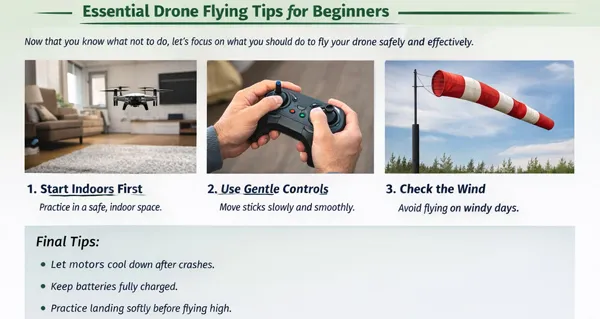
6. Understand Wind (Even Light Wind Matters)
Small drones are extremely affected by wind—even when it feels calm to you.
Wind tips:
- Avoid flying outdoors on windy days
- Fly early morning or evening for calmer air
- If the drone drifts, land immediately
If your drone struggles to move forward, the wind is already too strong.
7. Landing Safely (More Important Than Takeoff)
Most drone damage happens during landing.
Safe landing tips:
- Reduce throttle slowly
- Do not drop straight down
- Land on flat surfaces only
Pro tip:
Practice landing accuracy before flying higher.
8. What to Do After a Crash
Crashes happen—even to experienced pilots.
After a crash:
- Turn off the drone immediately
- Check propellers for damage
- Let motors cool for 1–2 minutes
- Never fly again immediately after a hard crash
Flying right after a crash can burn the motors.
9. Battery Management Tips
Proper battery care extends drone lifespan.
Battery best practices:
- Don’t drain to 0%
- Stop flying when power weakens
- Store batteries at room temperature
- Never charge hot batteries
Toy drone batteries typically last 7–10 minutes, which is normal.
10. Beginner Practice Routine (Recommended)
Follow this routine for fast improvement:
Day 1–2
- Takeoff and landing only
- Hover practice
Day 3–4
- Forward and backward movement
- Slow turns
Day 5+
- Side movement
- Simple obstacle navigation
Short, frequent practice is better than long sessions.
Final Thoughts: Fly Slow, Learn Fast
Flying a drone is a skill that improves with patience.
By starting indoors, using gentle controls, and understanding basic safety rules, even beginners and kids can enjoy drone flying safely.
Remember:
👉 Slow control = better flights
👉 Practice = fewer crashes
👉 Safety = more fun